

How to Choose a Demantoid Garnet

Nine minutes on how the Ural demantoid is found, cut and valued — with geologists of the Ural Branch of the Russian Academy of Sciences and the Ural Geological Museum.
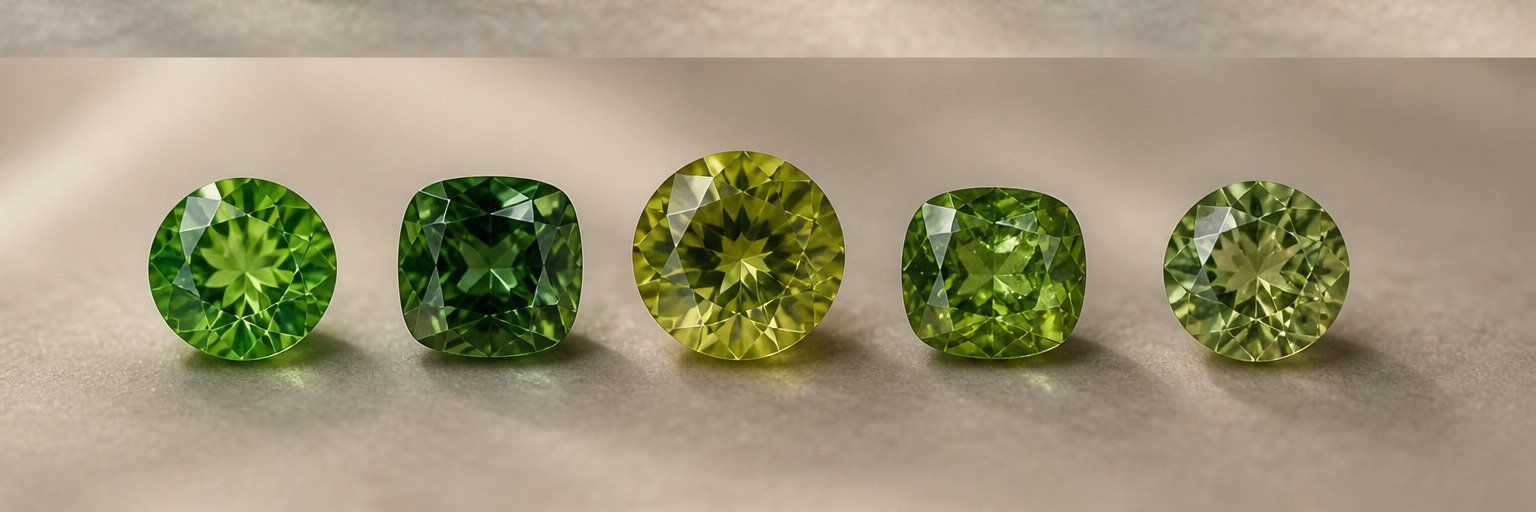
Demantoid is usually chosen by eye first, but the best stone is rarely the one with the strongest green in a single photo. What matters is how color, fire, clarity and cut behave together in the actual jewel you want to make.
That is why buyers so often hesitate between two good stones. A richer green demantoid can look impressive but hide some of the spectral fire that makes the gem special. A lighter yellowish-green stone may look more alive in motion. A visible horsetail may delight one collector and put off a buyer who wants a clean, modern ring. There is no universal top grade that suits every purpose.
This guide is meant to make that comparison easier. Use it to judge loose demantoids more deliberately, and to decide whether you should start with a single stone, a pair or a matched set.
The short buying checklist
Before requesting a price, ask for:
- weight and exact millimetre dimensions;
- photographs and video in more than one lighting condition;
- a face-up view and side view;
- a description of eye-visible inclusions;
- the stated origin and the basis for that statement;
- any available independent report or disclosure;
- confirmation that the shape and dimensions suit the intended setting.
Then compare the stone in this order: overall appearance, color, fire, cut, clarity, size and origin. Buyers who skip straight to a label or a locality claim usually miss something more important in the stone itself.
1. Start with color—but look beyond the word “green”
Demantoid is the green gem variety of andradite garnet. Its range extends from greenish yellow and yellowish green to intense green. Chromium contributes the valued green component, while iron contributes yellow. GIA's classic study of Russian demantoid describes emerald green as the rarest end of the range.[1]
When comparing stones, consider three separate properties:
- Hue: whether the stone leans yellowish green, green or slightly bluish green.
- Tone: how light or dark it appears.
- Saturation: how strong or muted the color is.
The preferred balance depends on the design and on your taste. Strong, even green is highly sought after, but a stone that goes too dark can start to look heavier than it looked in the seller's photo. Yellowish-green demantoid often shows its fire more freely because the body color masks fewer spectral flashes.
Do not make a final decision from a single studio photograph. Ask to see the stone in neutral daylight and ordinary indoor light. Camera processing, background color and strong LED illumination can materially change the way a green gem appears on screen.
2. Look for demantoid's fire
The name demantoid means “diamond-like,” a reference to its lustre and dispersion. Dispersion is the separation of white light into spectral colors. GIA reports a dispersion value of 0.057 for demantoid—one reason a well-cut stone can show vivid flashes of red, orange, yellow and blue.[1]
Fire is not something you can predict from species name alone. It depends on:
- body color and tone;
- facet angles and symmetry;
- polish;
- the size and placement of inclusions;
- the type and direction of illumination.
Rock the stone slowly under a small light source. Look for distinct colored flashes that move across the crown, not just white glare on the surface. Broad diffuse light is better for judging body color; a smaller directional light makes dispersion easier to see.
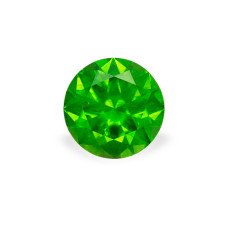
Compare real demantoids
See how green and fire shift between real stones — far more than any description conveys.
3. Judge clarity in context
Demantoid may contain crystals, healed fractures, needles, fibres or curved “horsetail” structures. Clarity should be judged by what an inclusion does, not simply by whether it exists.
Ask:
- Is it visible without magnification?
- Does it reduce transparency or interrupt the face-up color?
- Does it reach the surface or present a durability concern?
- Is it attractively positioned?
- Is it important to the collector story of the stone?
GIA notes that horsetail inclusions are among the unusual internal features that can increase a demantoid's value.[2] Yet not every horsetail is equally attractive, and not every buyer wants one. A fine, well-positioned spray may be a selling point to a collector; a dense inclusion beneath the table may simply get in the way of brilliance.
Most importantly, a horsetail is not proof of Russian origin by itself. Not all Russian demantoids contain one, and similar structures occur in material from other localities.[3] See our detailed guide to horsetail inclusions.
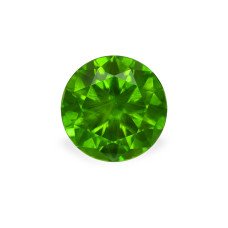
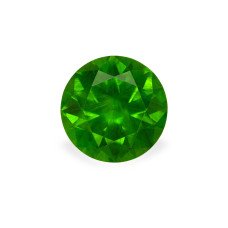
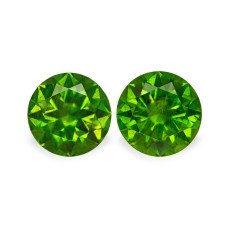
Demantoids with a visible horsetail
Stones whose clarity shows the horsetail inclusion prized in Ural material.
4. Examine the cut, not just the shape
Round, oval, cushion and pear are shape names. Cut quality describes how well the cutter has used angles, proportions, symmetry and polish to bring the material to life.
Look face-up for:
- even brightness across the stone;
- lively reflections as the gem moves;
- no large persistently dark or transparent “window” in the centre;
- balanced outline and symmetry;
- an even girdle suitable for setting;
- clean facet junctions and polish.
Demantoid rough is scarce, and cutters constantly trade beauty against weight retention and inclusions. For that reason, an excellent stone is not always cut to a standard commercial outline. A slightly unusual proportion may be the right decision if it preserves exceptional color or avoids a vulnerable fracture. Judge the finished result, not a textbook outline.
Demidoff works with Ural demantoids from the Korkodin deposit, managing the process from extraction and sorting to in-house cutting. That does not remove the need to judge each stone on its own merits, but it does mean the chain of custody is clearer than in a stone that has changed hands several times. You can read about that process on About Demidoff.
5. Understand carat weight and millimetre size
Carat is weight, not visual diameter. Two demantoids of the same weight can face up differently because of shape, depth and proportions. A design brief should therefore include both carat weight and exact length, width and depth.
Fine demantoids are commonly small. GIA's study of Russian material observed that most were under one carat and described large faceted stones as exceptionally rare.[1] Bigger is not automatically better. Size becomes important only when color, transparency and cut still hold up at that size.
For jewellery, work backwards from the setting:
- a centre stone requires the correct face-up presence and depth;
- earrings require two stones that behave as a pair;
- pavé and layouts require consistent millimetre dimensions;
- an existing mounting imposes tighter tolerances than a new bespoke design.
6. Treat origin as a separate question
Russia's Ural Mountains are the historic source of demantoid and remain strongly associated with vivid color, fire and the classic horsetail. Material is also found in Namibia, Madagascar, Iran, Italy, Pakistan and other localities. Different geological settings can produce different inclusion and chemical patterns, but visual appearance alone is not a reliable origin test. If a seller jumps too quickly from “looks right” to “therefore Ural,” that is usually a sign to ask better questions.
Ask the seller what “Ural” or a more specific locality claim is based on. A mine-to-cut chain, documented provenance and an independent laboratory opinion are different forms of evidence; they should not be treated as interchangeable. For a detailed, neutral comparison, see our demantoid origin guide.
7. Decide between a single stone, pair or set
Choose a single demantoid when one stone will carry the whole visual decision and the design can be built around it.
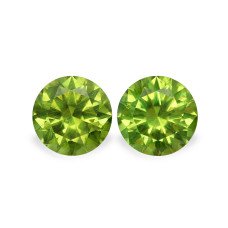
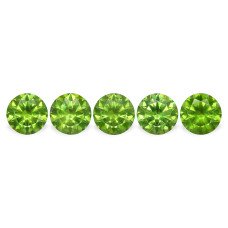
Choose a matched pair or set when the relationship between stones matters as much as each stone on its own. Earrings need balance in dimensions, color, tone, brilliance and apparent size. A suite or pavé layout may require dozens of stones that read as one group rather than as separate individuals.
Matching rare natural material is its own discipline. The live Demidoff catalogue currently shows 386 active demantoid singles and 52 active sets. That depth makes it possible to compare alternatives rather than forcing a design around the first approximate match. If you are buying for earrings or a suite, that depth matters. Read how jewellers choose matched demantoids.
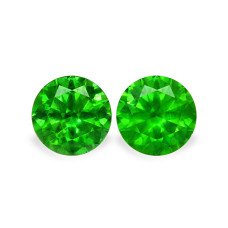
Matched pairs and sets
Matched material for earrings and suites, where consistency is the hard part.
Questions to ask before buying
Is the greenest demantoid always the best?
No. Strong green is highly desirable, but tone, transparency, fire, cut and the intended design all matter. A lighter stone with exceptional dispersion may be more compelling than a darker stone with less life.
Should I insist on a horsetail?
Only if it suits your purpose. An attractive horsetail can add collector interest, but its absence does not make a Ural demantoid inauthentic or inferior. Its presence alone does not establish origin.
Can I compare demantoids by carat weight alone?
No. Compare dimensions, face-up appearance, cut, color and clarity as well as weight.
Why are prices supplied on request?
Each stone combines origin, size, color, clarity and cut differently. Individual quotation lets the buyer compare the actual stones available now rather than rely on a generic price-per-carat table that says very little about a specific gem. See what determines demantoid value.
Choose with the intended jewel in mind
The best demantoid is not the stone with the longest list of selling points. It is the one that still looks convincing after you have asked awkward, specific questions about color, cut, clarity, size and origin.
Browse the full Ural demantoid collection, compare single stones and matched sets, or contact Demidoff with the dimensions, shape, color and intended use. That usually leads to a much better shortlist than starting with “show me your best stones.” We can prepare a focused selection for remote review, a Bangkok showroom visit or an upcoming gem show.
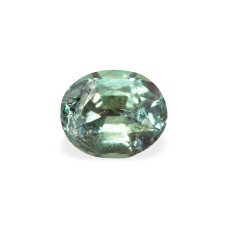
Other gems we cut
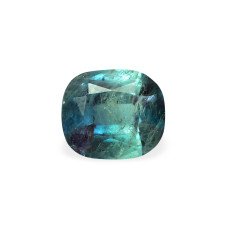
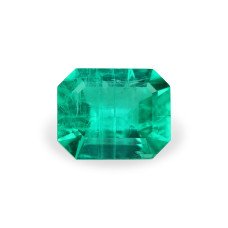
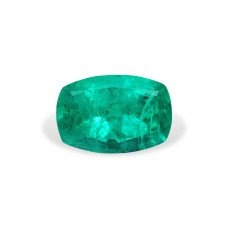
Alexandrite and emerald from other deposits — a different colour, the same standard of selection.
Sources
- W. R. Phillips and A. S. Talantsev, “Russian Demantoid, Czar of the Garnet Family,” Gems & Gemology, Summer 1996. https://www.gia.edu/dam/migrated-assets/docs/doc1/Russian-Demantoid-Czar-of-the-Garnet-Family.pdf
- GIA, “Garnet Gemstone” and garnet quality factors. https://www.gia.edu/garnet
- GIA, “Does a horsetail inclusion in demantoid guarantee Russian origin?” https://www.gia.edu/gia-faq-garnet-horsetail-inclusion