

Horsetail Inclusions in Demantoid: What They Reveal—and What They Don't

Nine minutes on how the Ural demantoid is found, cut and valued — with geologists of the Ural Branch of the Russian Academy of Sciences and the Ural Geological Museum.
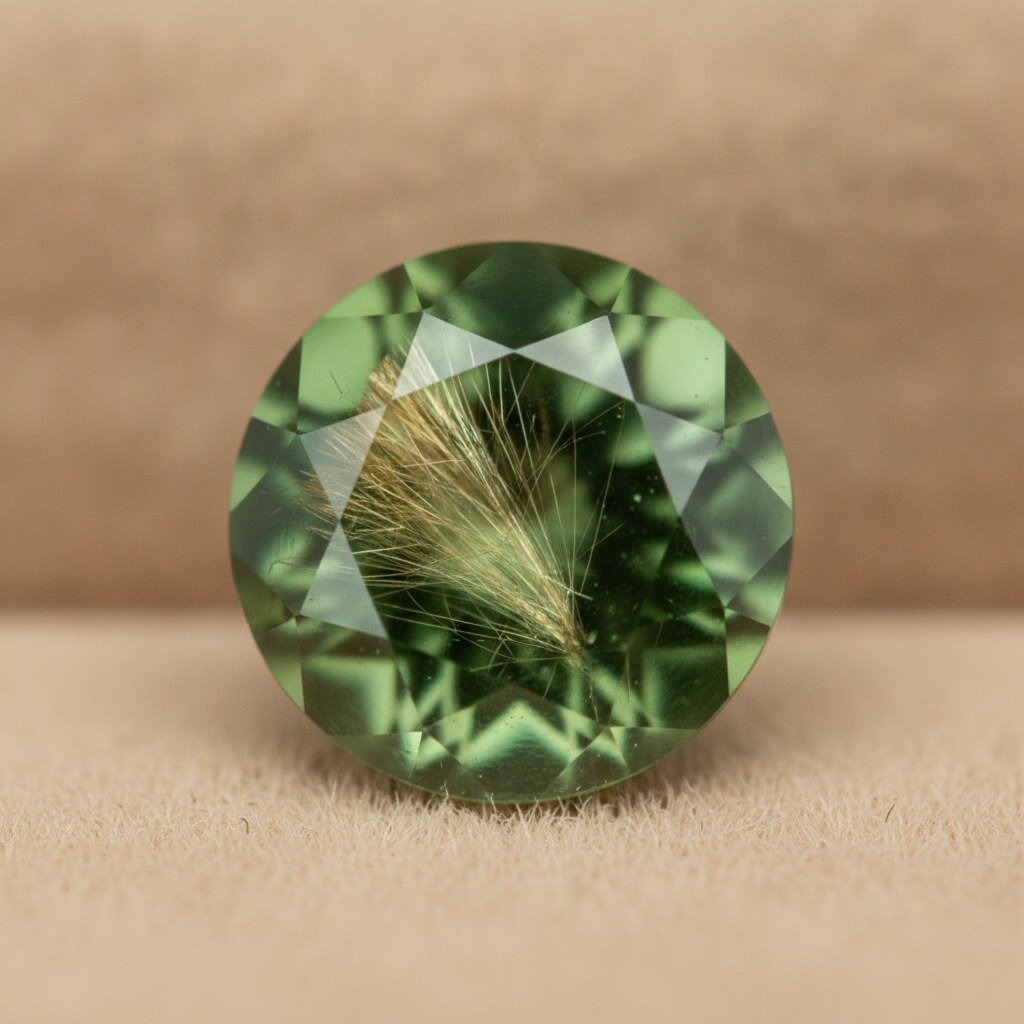
Few inclusions are actively sought in a faceted gemstone. The horsetail in demantoid is a famous exception: a fine radiating spray can give a stone an individual internal landscape and add collector interest.
It is also frequently misunderstood. A horsetail is not a certificate of Russian origin. It does not appear in every Ural demantoid, and related features are documented in demantoid from several other localities. It should be examined as an inclusion first and interpreted as one part of a larger body of evidence.
What does a horsetail look like?
A classic horsetail appears as fine, curved fibres or channels radiating from a small central point or crystal. Under magnification, the structure resembles a fan, plume or the flowing hairs of a horse's tail. It may be compact and subtle or spread across a large area of the stone.
Its appearance changes with:
- viewing angle;
- direction and intensity of light;
- magnification;
- facet reflections;
- position within the stone;
- density and curvature of the fibres.
A horsetail that is dramatic in darkfield illumination may be discreet in ordinary face-up viewing. Buyers should request both magnified imagery and a normal viewing video rather than assume one represents the other.
What are the fibres made of?
The simple textbook description is that Russian horsetails consist of chrysotile fibres radiating from chromite. Research has made that picture more nuanced.
GIA has reported work indicating that some Ural horsetails are hollow growth tubes partially filled with serpentine-group minerals, and that the exact formation mechanism remains under discussion.[1][2] Other studies have reported different materials in visually related structures from other localities.
For a buyer, the practical lesson is straightforward: “horsetail” describes a recognisable visual pattern, not a complete mineralogical diagnosis.
Why do collectors value horsetails?
Most inclusions reduce transparency or distract from a faceted gem. An attractive horsetail can do something different. It can:
- connect the stone to demantoid's collecting tradition;
- create a distinctive microscopic scene;
- provide an individual feature by which the stone can be recognised;
- contribute to the character of historic Ural material.
GIA identifies horsetails as one of the unusual inclusions that can increase a gem's value.[3] This is not automatic. A delicate, well-positioned fan is different from a dense mass that dulls the stone or a fracture that threatens durability.
Does a horsetail prove Russian or Ural origin?
No.
GIA's direct answer is that not all Russian demantoids have horsetails and that horsetails are also seen in demantoids from Iran and Italy.[4] Published research documents related fibrous structures in material from Pakistan as well.[1] GIA notes that they have not been observed in demantoids from Namibia or Madagascar in the same way.[4]
This means:
- presence is not conclusive: a horsetail does not uniquely identify Russia;
- absence is not conclusive: a Russian demantoid can lack a horsetail;
- appearance alone is insufficient: origin assessment may require microscopy, spectroscopy, chemistry, provenance and expert comparison.
Demidoff works with Ural demantoids from the Korkodin deposit, managing the process from extraction and sorting to in-house cutting, as described on About Demidoff. A buyer who needs an independent origin opinion should state that requirement for the specific stone.
Does a horsetail prove that a stone is natural?
It can be a meaningful natural internal feature, but no single observation should replace proper identification. GIA has even documented horsetail-like structures in brown andradite that did not have enough green color to be classified as demantoid.[5]
Identification asks whether the material is demantoid. Origin asks where it formed. Treatment disclosure asks whether it was modified. These are separate questions and may require different evidence.
How does a horsetail affect clarity?
There is no universal penalty or premium. Assess four things:
1. Face-up visibility
Can the inclusion be seen without magnification? Does it add texture, or does it interrupt color and brilliance?
2. Position
A fan beneath the table may be easy to appreciate but also more visually dominant. A feature near the edge may be subtle face-up and more vulnerable during setting if accompanied by a fracture.
3. Density
Fine, separated fibres can remain transparent. Dense material can create haze or reduce light return.
4. Structure
Do not confuse a decorative spray with a surface-reaching fracture. Ask for a side view and, for an important stone, an expert assessment of setting risk.
The right clarity profile depends on the purpose. A collector may actively seek a visible, photogenic horsetail. A jeweller may prioritise clean face-up appearance and consistent brilliance.
How to inspect a horsetail
Use a clean 10× loupe or gem microscope and diffuse light. Then change the illumination and angle slowly.
- Begin face-up without magnification. Judge the whole stone.
- Use 10× magnification to locate the central point and radiating structure.
- Rock the stone; facet reflections can duplicate or hide the feature.
- Examine from the side to understand depth and proximity to the surface.
- Compare brightfield and darkfield views if a microscope is available.
- Return to normal viewing. Decide whether the inclusion enhances or compromises the actual wearing appearance.
Avoid drawing mineralogical or origin conclusions from a phone macro image alone.
Demantoids with visible horsetails
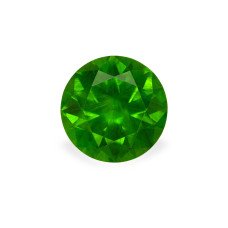
Current stones whose clarity notes a horsetail inclusion — inspect the real thing, not a definition.
What makes a collector-quality horsetail?
Collectors often respond to:
- a recognisable radiating form;
- fine, graceful curvature;
- good contrast under magnification;
- an attractive position within the cut;
- enough transparency and brilliance around the feature;
- documentation and provenance appropriate to the purchase.
Taste remains decisive. Some buyers want the horsetail to be visible immediately; others want an internal signature discoverable only through a loupe.
Horsetails in the Demidoff catalogue
In the active Demidoff inventory snapshot of 23 July 2026, 159 demantoid records carried clarity descriptions explicitly mentioning a horsetail: 84 “Included, Horsetail inclusion” and 75 “Slightly included, Horsetail inclusion.” Inventory changes, and a catalogue label is not a laboratory origin determination, but this depth allows buyers to compare different patterns and visibility levels.
Browse Ural demantoids or ask Demidoff to select stones by:
- desired carat or dimensions;
- color and tone;
- face-up clarity;
- subtle or prominent horsetail;
- single stone, pair or set;
- documentation requirements.
For the broader decision process, read how to choose a demantoid and what determines value.
Frequently asked questions
Are horsetail inclusions rare?
They are an unusual and celebrated feature of some demantoids, but their frequency varies by source and parcel. A fine, aesthetically placed horsetail is more specific than the mere presence of fibres.
Is a demantoid without a horsetail less valuable?
Not necessarily. Color, fire, size, cut, transparency, origin evidence and overall beauty may matter more. Many buyers prefer a cleaner-looking stone.
Can horsetails occur outside Russia?
Yes. GIA reports them in demantoids from Iran and Italy, and research also documents related structures in Pakistan.[1][4]
Should an earring pair have identical horsetails?
Usually the face-up match matters more than identical microscopic features. If the inclusions are visible without magnification, their visual weight should be considered when matching the pair.
Other gems we cut
Alexandrite and emerald from other deposits — a different colour, the same standard of selection.
Sources
- U. Hennebois et al., “Faceted Demantoid Garnet with Spectacular ‘Horsetail’ Inclusions,” Gems & Gemology, Winter 2021. https://www.gia.edu/gems-gemology/winter-2021-microworld-faceted-demantoid-garnet-horsetail-inclusions
- S. Nagai, M. Saito and M. Miura, “Unusual ‘Horsetail’ and Columnar Inclusions in Demantoid,” Gems & Gemology, Winter 2022. https://www.gia.edu/gems-gemology/winter-2022-microworld-unusual-horsetail-and-columnar-inclusions-in-demantoid
- GIA, “Garnet Gemstone.” https://www.gia.edu/garnet
- GIA, “Does a horsetail inclusion in demantoid guarantee Russian origin?” https://www.gia.edu/gia-faq-garnet-horsetail-inclusion
- T. Okada and P. G. York, “Cat's-Eye Demantoid and Brown Andradite with Horsetail Inclusions,” Gems & Gemology, Spring 2018. https://www.gia.edu/gems-gemology/spring-2018-labnotes-cats-eye-demantoid-and-brown-andradite-with-horsetail-inclusions