

Every stone that leaves us above a certain size travels with a laboratory report. Most buyers look at two things — the seal at the top and the carat weight — and then file the paper away. That is a waste. Almost everything you paid the laboratory for sits in the lines nobody reads.
Below are three reports on stones that passed through our hands: a 2.48 ct demantoid examined by GIA, a 1.06 ct demantoid examined by AGL, and a 2.58 ct Russian emerald examined by ICA GemLab in Bangkok. Three laboratories, three formats, three different questions answered. Here is how to read each of them, line by line.
Who signs the report matters as much as what it says
GIA, the Gemological Institute of America, has been in business since 1931 and wrote much of the vocabulary the trade now takes for granted. Its identification report answers one question with great precision: what is this stone, and has anything been done to it. The wording is deliberately narrow — GIA describes colour in a controlled vocabulary, not in the language of a sales pitch.
AGL, American Gemological Laboratories in New York, opened in 1977 and was the first American laboratory to issue country-of-origin reports. Its Prestige Gemstone Report puts provenance in a box of its own, with the laboratory's reasoning stated next to the verdict.
ICA GemLab works in Bangkok under the International Colored Gemstone Association. For coloured stones traded through Asia it is the address where most origin questions are settled, and its reports carry the names of the gemmologists who signed them.
1. GIA report 6262482158 — what the stone is
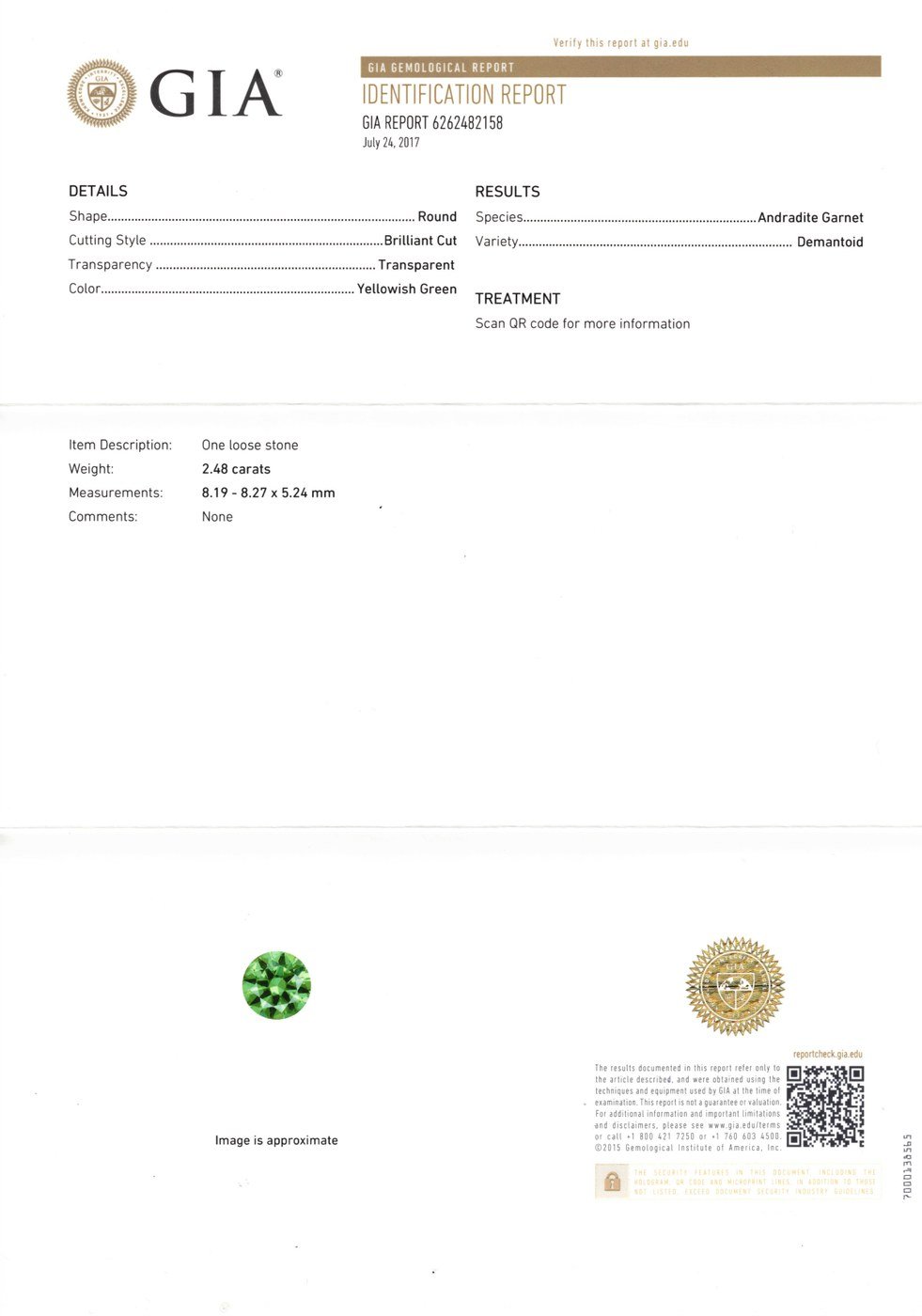
The first thing to read is not the weight but the two lines under RESULTS. Species: Andradite Garnet. Variety: Demantoid. Species is the mineral, variety is the name the trade uses for a particular appearance of it. Every demantoid is an andradite; not every andradite earns the name demantoid. A report that names only the variety, without the species behind it, is telling you less than it appears to.
Then the description: round, brilliant cut, transparent, colour yellowish green. That last phrase is not an opinion about beauty. GIA works from a fixed vocabulary, and "yellowish green" places the stone precisely between the greens and the yellows of that scale. Sellers who describe the same stone as "vivid emerald green" are not quoting the laboratory.
The measurements — 8.19–8.27 × 5.24 mm at 2.48 carats — repay a moment's attention. Two diameters are given because a round stone is never perfectly round; eight hundredths of a millimetre between them is a tight, well-cut circle. The depth against the diameter tells a cutter whether the stone was cut for weight or for light.
And the line most people skip: Comments: None. On a GIA report, silence in that field is information. It is the space where treatments, fracture filling and anything else worth flagging would appear.
The report number is printed at the top for a reason. Anyone can enter 6262482158 at reportcheck.gia.edu and see the same data GIA holds. A seller who shows you a photograph of a report but declines to give the number is asking you to trust the photograph.
2. AGL report CS 8085484 — where it came from
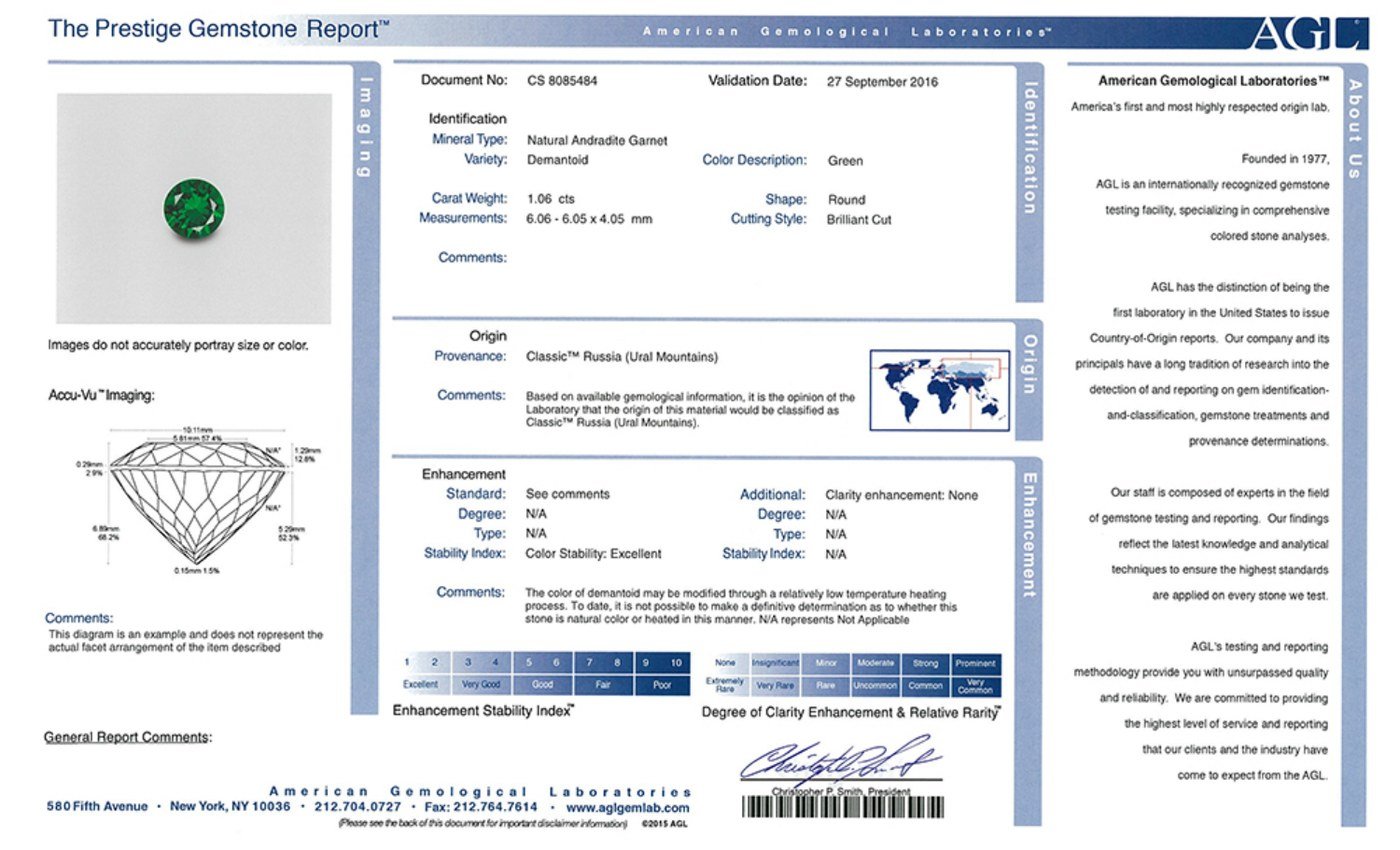
AGL builds its report in labelled panels, and the one headed Origin is the reason this document exists. It reads: Provenance: Classic™ Russia (Ural Mountains).
The word Classic is doing real work there. AGL applies it to the historic sources that gave a gem variety its reputation — for demantoid that means the Urals, where the stone was first found in the 1850s and where the material against which everything else is measured still comes from. The laboratory then states its reasoning in the comments beside the verdict: on the gemmological evidence available, this is how the origin of this material would be classified. Origin is a judgement built on comparison, and AGL says so on the face of the document rather than burying it.
Under Enhancement, the line that matters commercially: Clarity enhancement: None. No filler in the fractures, nothing introduced to make the stone look cleaner than it is.
On the left sits the Accu-Vu diagram — a scale drawing of the stone's proportions with crown and pavilion percentages. It is not decoration. Two demantoids of equal weight and equal colour can differ sharply in how they return light, and the proportions are where that difference is recorded in numbers rather than adjectives.
3. ICA GemLab report 160013 — a Russian emerald
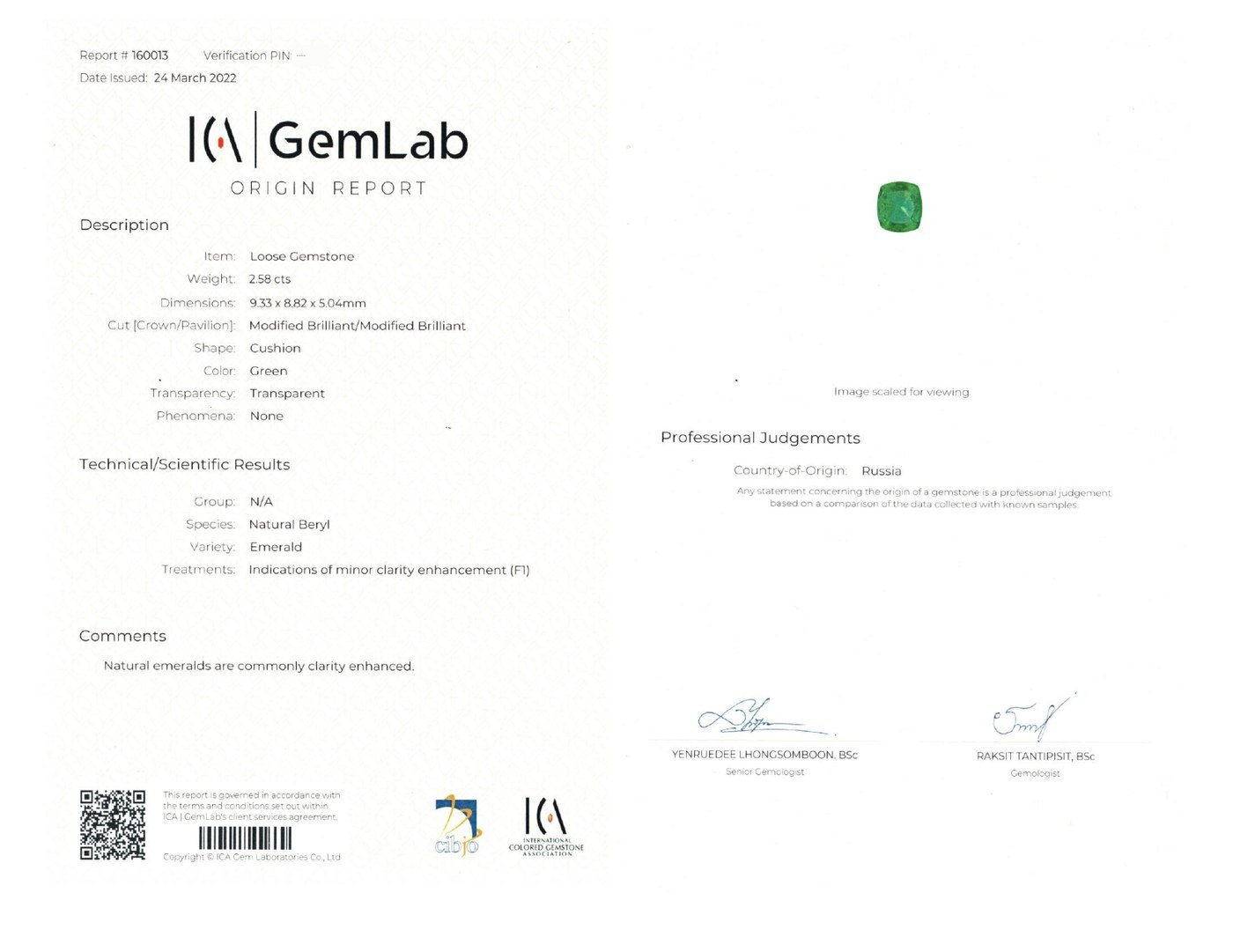
This one is headed Origin Report, and the structure follows from that. Description first — natural beryl, variety emerald, 2.58 cts, cushion, modified brilliant crown and pavilion, 9.33 × 8.82 × 5.04 mm. Then, under Professional Judgements: Country-of-Origin: Russia.
Read the sentence printed underneath it, because it is the most honest line on any of these three documents: any statement about origin is a professional judgement based on comparison with known samples. Laboratories hold reference collections of stones with documented provenance and match trace-element chemistry and inclusions against them. That is why origin appears under judgements while weight and dimensions appear under description. One is measured, the other is concluded.
Under Technical Results: indications of minor clarity enhancement (F1), with the comment that natural emeralds are commonly clarity enhanced. The F-scale runs from F1 to F3 — minor, moderate, significant — and F1 is the bottom of it. Emerald grows fractured; the trade has filled those fractures with oil for centuries and a laboratory reports the degree rather than pretending it does not happen. An emerald report with no enhancement line at all is more suspicious than one that says F1.
The signatures at the bottom belong to Yenruedee Lhongsomboon, Senior Gemmologist, and Raksit Tantipisit. If she looks familiar, she speaks in our film about the Ural demantoid — on exactly this subject, how a laboratory establishes where a stone was born.
This emerald is still with us: Emerald 2.58 ct cushion, 9.33 × 8.82 mm — the stone described in report 160013 above.
What a report will not do for you
It will not price the stone. GIA prints the disclaimer in small type at the foot of every report: the document is not a guarantee or a valuation. Value comes from colour, size, cut and the market on the day; the laboratory establishes facts, and what those facts are worth is a separate conversation.
It will not describe beauty either. Two demantoids can carry identical wording — andradite, demantoid, yellowish green, comments none — and sit at different prices because one of them comes alive under the light and the other does not. That part still has to be seen.
What the report does is remove doubt from everything that can be established: what the stone is, where it came from, and what has been done to it. On a Ural demantoid, where origin carries most of the value, that is the larger part of the question.
Tell us what you are looking for and we will send available stones with their reports.